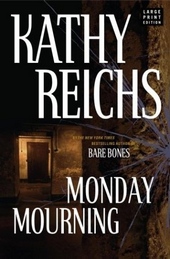
Monday Mourning
- Автор:Кэти Райх
- Раздел:Легкое чтение, Детективы, Триллеры
О книге «Monday Mourning»
Читать «Monday Mourning» онлайн бесплатно
Streetlights were on, shops were closing, pedestrians were hurrying, heads bent, purses and packages pressed to their chests.
Leaving boulevard René-Lévesque, I followed rue Berri to its southern end, then turned west and crept along rue de la Commune. To our right, the narrow lanes of Vieux-Montréal crisscrossed the hill. To our left lay le Marché Bonsecours, le Pavillon Jacques-Cartier, les Centre de Sciences de Montréal, beyond them the St. Lawrence, its water a black sheen like ebony ice.
“It’s beautiful,” Anne said. “In an arctic tundra sort of way.”
“Cue the caribou.”
In the ice-free months ships belly up to quays jutting from the river’s edge, and cyclists, skateboarders, picnickers, and tourists throng the adjacent parklands and promenades. This evening the riverfront was still and dark.
At the head of place d’Youville, I turned onto a small side street, and parked opposite the old customs house. Anne followed as I trudged downhill, threading her way drunkenly in my tracks."
"Glancing across the river, my gaze fell on the snow-misted outline of Habitat ’67. Built for World Expo, the complex is a pile of geometric cubes that challenges the delicate art of balance. Born more of imagination than architectural pragmatism, Habitat’s walkways and patios are a delight in summer, an invitation to hypothermia in winter.
Andrew Ryan lived in Habitat.
A multitude of questions sidetracked my concentration.
Where was Ryan? What was he feeling? What was I feeling? What had he meant? The need to talk. Agreed. But about what? Commitment? Compromise? Conclusion?
I pushed the questions aside. Ryan was working an operation and not thinking or feeling anything having to do with me.
At de la Commune, we entered a futuristic gray stone building, all corners and angles. High up, a banner draped one tower. ICI NAQUIT MONTRÉAL. “Where Montreal Was Born.”
“What is this place?” Anne stomped snow onto the green tile floor.
“Pointe-à-Callière, Montreal’s Museum of Archaeology and History.”
A man’s face rose from below a circular desk at the far end of the lobby. It was gaunt and pale, and needed a shave.
“Sorry.” Rising, the man pointed to a sign. He was wearing an army surplus overcoat, and holding a boot in one hand. “The museum is closed.”
“I have an appointment with Dr. Mousseau.”
Surprise. “Your name, please?”
“Tempe Brennan.”
The man punched a number, spoke a few words, then cradled the receiver.
“Dr. Mousseau is in the crypt. Do you know the way?”
“Yes, thank you.”
Crossing the lobby, I led Anne past a small theater, down a set of iron stairs, and into a long, narrow, softly lit hall, its walls and floor made completely of stone.
“I feel like Alice tunnel-chasing the hatter,” said Anne.
“This point of land was the site of Montreal’s first settlement. The exhibit demonstrates how the city has grown and changed over the past three centuries.”
Anne flapped her gloves at a truncated wall rising from the floor. “The original foundations?”
“No, but old.” I pointed to the far end of the hall. “That walkway lies directly below place d’Youville, near where we parked. What’s now street was once a sewage dump, before that a river.”
“Tempe?” The voice rang hollowly off rock and mortar. “Est-ce toi, Tempe?”
“C’est moi.”
“Ici.” Over here.
“Who’s Mousseau?” Anne whispered.
“The staff archaeologist.”
“I’ll bet the woman’s got buttons.”
“More buttons than a political primary.”
Monique Mousseau was working at one of several dozen glass cases lining the corridors spidering off from the main chamber. At her side, a metal cart held a camera, a magnifying glass, a laptop, a loose-leaf binder, and several books.
Seeing us, Mousseau reshelved an object, closed and locked the cabinet, dropped Harry Potter glasses to her chest, and hurried toward us.
“Bonjour, Tempe. Comment ça va?”
Mousseau kissed each of my cheeks, then stepped back and beamed up at me, hands still clasping my upper arms.
“You’re good, my friend?”
“I’m good,” I replied in English, then introduced Anne.
“A very great pleasure to meet you.” Mousseau cranked Anne’s arm as one would a pump handle.
“Likewise.” Anne stepped back, overwhelmed by the tiny cyclone working her limb.
The two women looked like members of different species. Anne was tall and blonde. Mousseau stood four foot eleven and had curly black hair. Anne was swathed in pink angora. The archaeologist wore a khaki boy’s shirt, black jeans, and lumberjack boots. An enormous wad of keys dangled from one belt loop.
“Thanks for agreeing to see us so late on a snowy Friday,” I said.
“Is it snowing?” Mousseau released Anne and swiveled to me, bouncing like someone jiggered on speed.
I’d met Monique Mousseau a decade back, soon after my first sortie to Montreal.
Похожие книги по жанрам

Сотня. Забытый поход
- Ерофей Трофимов
- Легкое чтение, Фантастика

Семь снежинок на ладони
- Светлана Нарватова
- Легкое чтение, Фэнтези

Плюс сайз. Охота на миллионера
- Инга Максимовская
- Легкое чтение, Любовные романы

Не отпущу
- Алиса Верди
- Легкое чтение, Любовные романы
Гримуар темного лорда II (СИ)
- Тимофей Грехов
- Легкое чтение, Фантастика
Ярар. Начало
- Тимофей Грехов
- Легкое чтение, Фантастика