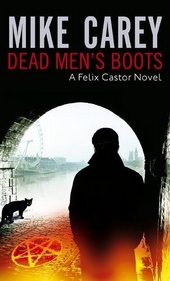
Dead Men's s Boots
- Автор:Mike Carey
- Раздел:Легкое чтение, Фэнтези, Городское фэнтези
О книге «Dead Men's s Boots»
Читать «Dead Men's s Boots» онлайн бесплатно
Before long, Sumner assured his readers, this real-life femme fatale was undertaking hits on her own: Jackie provided the gun, and the training in how to use it. Over the next five years Kale became something of a celebrity in Mob circles, without ever coming to the attention of the police. She made at least nine hits (Sumner argued passionately for the higher and more headline-grabbing score of thirteen) and was paid sums of up to eighty thousand dollars a time. At one point, Phil Alderisio reputedly kept her on retainer.
The cigarette-burn motif, meanwhile, had become a tabloid legend, and incorruptible police chief Art Bilek made a public commitment to bring in ‘the Mob killer who signs his work in this odious manner’. In 1968 he caught up with her in yet another hotel room, on the top floor of the Salisbury: the trappings this time were opulent rather than sleazy, and Kale was a guest of Tony Accardo, but neither the exclusive surroundings nor the distinguished patronage saved her when Bilek’s men surrounded the building and moved in to arrest her.
She added another man to her score as the cops broke the doors of the suite down and burst in on her. She was stark naked, according to the papers – fresh out of the bath, manicured and smelling of Madame Rochas, she shot the first man to walk through the door, twenty-two-yearold constable Dermot Callister, in the face, killing him instantly. She herself was shot seven times within the next few seconds (the bullets were later removed, counted, inventoried, stolen and sold for souvenirs) but still managed to wound three more officers before being taken alive. And her will to live must have been truly extraordinary, Sumner pointed out, because one of those bullets hit her liver and another collapsed her left lung. It was a miracle she survived long enough to go to court; long enough to spend three years on death row; long enough to die, at last, at a time and place of the state’s choosing.
That was the rough outline of the story Sumner told, but he embellished it along the way with some fairly elaborate reconstructions of Kale’s sexual encounters with the made men of the Chicago mob scene. I wondered what his sources were for some of the more circumstantial accounts: maybe Kale kept a journal or something. ‘Dear diary, you’ll never guess with which widely feared psychotic gang-lord I had a knee-trembler in the lift at Nordstrom’s today – or what he likes to be tickled with.’
I was only skimming, but even so my attention was starting to wander long before I got to the end. It’s not that I’m prudish, or even morally fibrous, but pornography that’s writ kt&# beten as a list of sexual positions and uses the word ‘turgid’ as though it was punctuation gets old fairly quickly.
I skipped to the last chapter, which turned out to be an account of Myriam Kale’s last two hits – the ones she was meant to have carried out from beyond the grave. In 1980 a guy who lived on George Street in Edinburgh was murdered in his own bathroom. Forensic evidence suggested that he’d been murdered immediately after sex, and his cheek and temple were scarred by post-mortem cigarette burns.
In 1993, ditto: some middle-aged sales rep in Newcastle left work on a Friday night, announcing his intention to ‘get laid, get wrecked and get to bed early’. He was found the next day in the laundry room of a hotel on Callerton Lane, stuffed into one of the baskets. Again, his face had been burned, and again there was evidence that he’d been engaging in coitus before meeting his violent death.
Cause of death in both cases was blunt-instrument trauma, and the weapons were never recovered. Sumner offered no explanation at all as to why Kale should have chosen the British Isles as the site of her post-mortem adventures: he just presented the facts, humbly and pruriently, for our consideration.
For a change of pace, I dug out the bag of bits and pieces that Carla had retrieved from behind John’s desk drawer. I flipped through the pages of the A to Z again, this time with my own oversized hardcover London street guide beside me on the bed, and got slightly more out of it this time. The list of place names – Abney Park, Eastcote Lane, St Andrew’s Old, St Andrew’s Gardens, Strayfield and the rest – turned out to be a list of London cemeteries. A pretty exhaustive list, too, I was guessing, because it ran to well over a hundred sites. Most had either been struck through with a single strike of the pen or had a large cross next to them on the line where they appeared. Whatever John had been looking for, it looked like he’d had really exacting standards.
At the bottom of the page, set off from the list by a couple of inches of glaringly empty space, was a single word: SMASHNA. It wasn’t crossed out, but John had circled it again and again in red ink. He’d then added three question marks in green.
Похожие книги по жанрам

Сотня. Забытый поход
- Ерофей Трофимов
- Легкое чтение, Фантастика

Семь снежинок на ладони
- Светлана Нарватова
- Легкое чтение, Фэнтези

Плюс сайз. Охота на миллионера
- Инга Максимовская
- Легкое чтение, Любовные романы

Не отпущу
- Алиса Верди
- Легкое чтение, Любовные романы

Гримуар темного лорда II (СИ)
- Тимофей Грехов
- Легкое чтение, Фантастика

Ярар. Начало
- Тимофей Грехов
- Легкое чтение, Фантастика