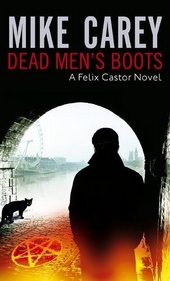
Dead Men's s Boots
- Автор:Mike Carey
- Раздел:Легкое чтение, Фэнтези, Городское фэнтези
О книге «Dead Men's s Boots»
Читать «Dead Men's s Boots» онлайн бесплатно
We had no choice in any case, because the bottom of Ropery Street was blocked off: the building site that Todd had mentioned extended on both sides of the road, and oversized earth movers prowled behind the plywood hoardings like wind-up dinosaurs in some mechanical equivalent of Jurassic Park.
Mount Grace had a small frontage out on the street, but the grounds were deceptively spacious. They opened out in front of us as we rounded the oxbow drive, lined on both sides with tall yews, and we got a glimpse of the formal gardens of cmalronf to our left. They were a pretty but slightly sombre prospect, dominated by funereal cypress trees and heavy, po-faced stone balustrades. Two massive stone urns flanking an arched gateway with passion flowers trained up it on both sides marked the entrance to the garden of remembrance. Kind of an odd choice, was my first thought: then I remembered someone telling me that the passion referred to is the passion of Christ, so I guess it was all as per the party line. Death and resurrection: pay now, and live later.
The crematorium itself was pretty damn impressive, though. It was built in cream-coloured stone, its main mass coming forward to meet the drive while two wings extended towards the rear of the grounds on either side. It was crenellated, with scalloped curves rather than straight ups and downs: the overall effect made it look as though the building had been assembled out of jigsaw pieces.
I enjoyed it while I could. As I got closer, the presence of the dead announced itself first as a pressure, then as something like a continuous bass throbbing at the limits of my perception. As I think I mentioned before, I hate cemeteries. Crematoria are no better and no worse: they’re places where my death-sense wakes up like a jumpy nerve in a tooth.
The cortège rolled onto the gravel drive, the hearse itself taking pole position in front of the crematorium’s massive oak door. From this close up I got an even better view of the architecture. There were ornate carved crowns over the windows, and the remains of some very weathered bas-relief sculptures on the corners of the building – faceless caryatids supporting the actual cornices on their bent backs, scarred and blackened by generations of rainwater to the point where you couldn’t even guess what figures they’d been meant to represent. The four winds? The four elements? The Four Tops?
Our bearers had been travelling in the car behind. They got out first, opened the back of the hearse and slid out the runners, ready to move on Todd’s command. At the same time a man who had been standing on the front steps of the crematorium came down to greet us. From his appearance, I guessed that he wasn’t the clergyman Todd had mentioned: he was in his late twenties or early thirties, with white-blond hair and a craggy, stolidly handsome face. He was built like a rugby forward, but his face wore a solemn, measured expression that made me wonder whether my first impressions had been wrong: maybe he had taken holy orders, out in Beverly Hills somewhere. His slate-grey linen suit was as good as Todd’s; maybe better. The one I was wearing came from Burton’s. I generally pick them up in the sales when they’ll throw you in an extra pair of trousers for free, so you’ll appreciate that there are gaps in my sartorial education: once you get past the thousand-quid mark, my eye’s not good enough to make the fine distinctions.
We got out of the hearse. Todd and the newcomer locked stares in a way that was definitely hostile: viscerally, bitterly hostile, and bleeding out of their pores despite the constraints of the situation.
‘Maynard.’ The blond man held out his hand, and Todd stared at it for a moment, nonplussed. Then, looking cornered and unhappy, he took it, shook it in a single staccato up-down movement, and let it go again.
‘Mister Covington,’ he said. ‘I didn’t expect to see you here. It’s very good of you to come.’ There was a slight thickening in his voice: it cost him an effort to get those words out.
The blond man shrugged easily. ‘I was in the neighbourhood,’ he said. ‘It seemed silly to pass the keys on to Fenwick or Digby when I could just come and open up myself.̵ cp m17;7;
There was a perceptible pause. ‘Yes,’ said Todd. ‘I see. This is Mrs Gittings, and this is Felix Castor. And – umm –’ turning to us ‘– this is Peter Covington.’
Covington gave me the briefest of nods and turned his attention to Carla. I could see she was impressed: there was a sudden warmth that I could feel from where I was standing – a wave of easy benevolence that made the air around us ripple with a virtual heat haze. ‘I was sorry to hear about your loss,’ he said, and I think she believed him. Certainly she let him take her hand and squeeze it. He looked soulfully into her eyes, and for a long moment she looked back.
Похожие книги по жанрам
Сотня. Забытый поход
- Ерофей Трофимов
- Легкое чтение, Фантастика
Семь снежинок на ладони
- Светлана Нарватова
- Легкое чтение, Фэнтези

Плюс сайз. Охота на миллионера
- Инга Максимовская
- Легкое чтение, Любовные романы

Не отпущу
- Алиса Верди
- Легкое чтение, Любовные романы
Гримуар темного лорда II (СИ)
- Тимофей Грехов
- Легкое чтение, Фантастика
Ярар. Начало
- Тимофей Грехов
- Легкое чтение, Фантастика