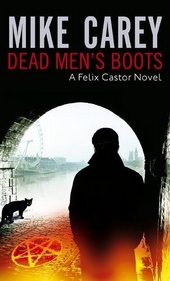
Dead Men's s Boots
- Автор:Mike Carey
- Раздел:Легкое чтение, Фэнтези, Городское фэнтези
О книге «Dead Men's s Boots»
Читать «Dead Men's s Boots» онлайн бесплатно
This time I won’t even send John to sleep: I just want to calm him a bit so you don’t have to go to bed in full body armour.’
I waited for her to respond. Finally she gave me the merest hint of a nod, as though she didn’t trust herself to speak.
I played a tune that was vaguely based on Neko Case’s ‘Lady Pilot’, I think purely because of the line in that song about not being afraid to die. Often in these cases it doesn’t seem to matter all that much what the song is when it starts out: once I let it out into the open air it grows and changes, as though the vibrations of the music are some sort of insubstantial extension of my own nervous system. It becomes something that I use to touch the world – the invisible world that seems to be idling next to our own right now at some inter-dimensional red light – and to operate on the things I see and feel there.
Opening my mind a little more this time, I met head-on the spirit that was waiting in the dark, and was struck by the sheer intensity of its rage: it was like scalding water, filling the room unseen and unfelt until now. The strength of it – the strength of the will behind it – took me by surprise. None of the interactions I’d ever had with John had made me suspect that he could be capable of that kind of ferocity. Matching it high for high, low for low, I let the music fall into it like a calving iceberg and slowly, gradually, take away its power to hurt.
I lose track of time when I’m doing this stuff. Or maybe it’s fairer to say that time becomes one of the dimensions of the music, and I can only perceive it as something that’s moving in my chest and under my fingers, flowing out into the pattern that I’m making. In any case, when I finally surfaced I found that Carla was asleep next to me.
The geist wasn’t asleep but it was quiescent: it wouldn’t be throwing any more beer bottles around for a w [aro2emhile. I felt queasy all over again as I thought about the contrast between the vaguely well-meaning, more or less ineffectual man I’d known for the past fifteen years and this baleful ball of hate and wrath. Death changes you – in some cases, brings out the worst in you – but that didn’t make it any easier to take right then. Particularly since I found myself wondering whether John Gittings might still be alive if I’d taken his calls.
My internal logic-checker kicked in on my side at that point. You can’t save someone from suicide if they’re serious about making the effort. John had wanted and intended to die: that much had to be true. Even in New York City, where they’re meant to have those giant alligators in the sewers, people don’t casually take loaded shotguns into the toilet with them.
And if it was murder dressed up as suicide . . . ? But that really sounded like Mister Paranoia dropping in for tea.
On paper, in theory, in the cold light of day, I had nothing to reproach myself with. But this was the dark night of John Gittings’s soul, and I couldn’t let myself off the hook that easily.
I picked up my stuff and went through into the bedroom, where I unrolled the sleeping bag on the stripped bed. There’s something cold and unlovely about a bare mattress: I tried not to look at it as I unpacked the rest of my gear from a ragged-arsed overnight bag that used to belong to Rafi.
Then I slipped off my shoes, sat back on the bed with my feet up, and finally peeled the layers of duct tape away from the Sainsbury’s bag that John had squirreled away so carefully. The bag started to tear, and a few small items fell out before I’d finished unwrapping it: a small key on a knotted shoelace, and the torn back of a matchbook from some place called the Reflections Café Bar. That left one bulky rectangular object.
From what Carla had already told me, I wasn’t expecting very much. But the biggest item in the bag was an object of such spectacular banality that I felt a sense of bathos and let-down even as I pulled it clear of the plastic and stared at the cover. It was an A to Z of London: one of the larger ones, spiral-bound.
I flexed it with my thumb and riffled through it. It had been marked up in black felt tip on almost every page – lines and circles sketched in, and in some cases scribbled out again afterwards, so that you mostly couldn’t see the features they were originally meant to be indicating. At least one of them was a church.
And that was it. Not much to go on, at first glance: not much to indicate what John had meant when he said that this was one for the books. Unless geographical gazetteers were the books he had in mind.
Further examination, though, showed that he’d used the A to Z as a notebook, too. The inside front and back covers and the blank spaces on the title and copyright pages were filled with densely written lists.
Похожие книги по жанрам

Сотня. Забытый поход
- Ерофей Трофимов
- Легкое чтение, Фантастика

Семь снежинок на ладони
- Светлана Нарватова
- Легкое чтение, Фэнтези

Плюс сайз. Охота на миллионера
- Инга Максимовская
- Легкое чтение, Любовные романы

Не отпущу
- Алиса Верди
- Легкое чтение, Любовные романы
Гримуар темного лорда II (СИ)
- Тимофей Грехов
- Легкое чтение, Фантастика
Ярар. Начало
- Тимофей Грехов
- Легкое чтение, Фантастика